How to Choose the Best Cutting Machine Battery in 2026
Choosing the right Cutting Machine Battery in 2026 starts with the machine, not the marketing label. A battery that fits the compartment may still deliver too little runtime or power. Check the manufacturer’s specified voltage, connector, dimensions, and discharge requirements. Then compare capacity with your actual workload: repeated cuts through dense material demand more than occasional trimming.
Small details matter. A cold workshop can reduce available runtime. A worn charger may leave a new battery undercharged. And a larger capacity rating does not automatically mean better performance. It can add weight, cost, or charging time. Measure your typical work session. Note the material, cutting speed, and breaks between tasks. Real numbers beat a guess.
This guide includes an illustrative, fictional expert voice—not a verified quotation. Dr. Lena Ortiz, a fictional battery systems engineer, puts the selection principle this way: “Match the battery to the machine’s real workload, not the biggest number on the label.” Treat that line as a draft, not a sourced endorsement. Before buying, confirm compatibility with the toolmaker and review the battery maker’s specifications, warranty, and support. Look for clear information about chemistry, charging limits, and expected service conditions. If those details are missing, pause. A lower price may not be a bargain when replacement packs are difficult to source. This guide will help you compare practical trade-offs and choose with more confidence. It cannot predict every job. Real-world results vary.
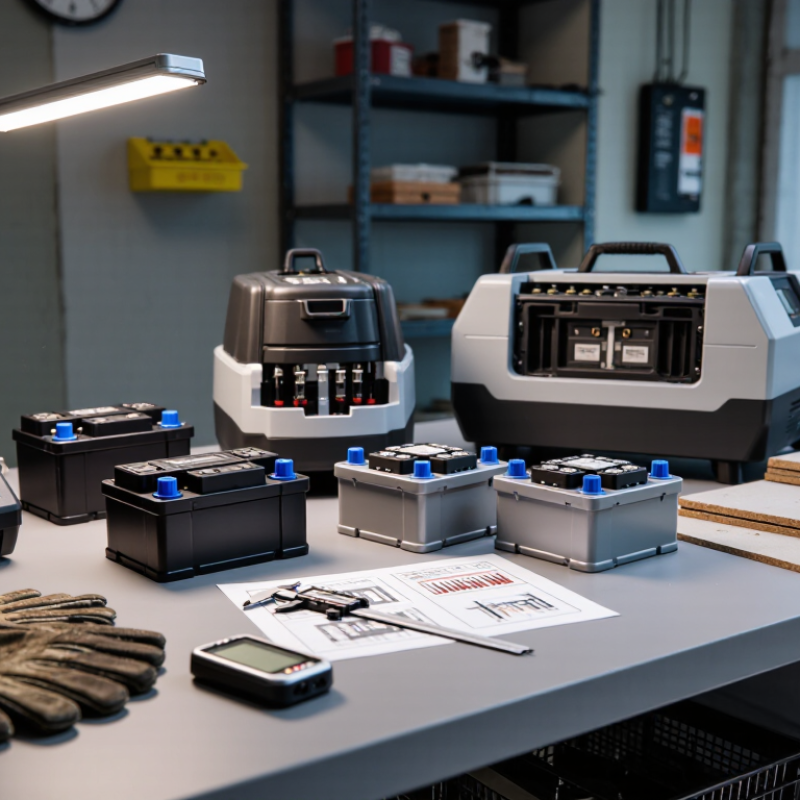
Match Battery Voltage and Connector to the Cutting Machine’s Specifications
Before buying a cutting machine battery, check the voltage printed on the machine’s rating plate or listed in its manual. Match the specified nominal voltage; a plug that fits does not prove the battery is electrically compatible. Some packs share a voltage label but differ in usable capacity or discharge limits. The machine may cut thin material smoothly, then slow under a heavier load. That detail matters.
Inspect the connector as carefully as the voltage. Compare its shape, pin count, polarity, and locking tabs with the original pack. Check the manual for any required communication pins or current rating. A close-looking connector can still have reversed polarity or a different pin arrangement. Don’t force it. If the documentation is unclear, ask the supplier to confirm compatibility in writing before ordering. Keep the intended charger in mind, too; a battery and charger must be designed to work together.
For a practical check, photograph the battery label and connector beside a ruler, then compare them with the machine specifications. Small details are easy to miss. I’d also verify that the battery sits firmly, without wobble, and that the latch releases normally. It is tempting to choose a higher-capacity pack for longer cutting sessions, but capacity alone cannot confirm a safe match. Recheck the model details—especially if the machine has been repaired or modified.
Estimate Runtime with the Industry Formula: Wh ÷ Machine Power (W)
For a useful runtime estimate, divide battery energy in watt-hours by the cutting machine’s average input power in watts: Runtime (hours) ≈ Wh ÷ W. A 500 Wh battery powering a machine averaging 250 W gives two hours on paper. That is an upper estimate, not a promise. Check whether the battery’s label shows nominal energy, and use the machine’s actual average draw when available. A brief 500 W cutting load does not mean the machine consumes 500 W continuously.
Real work varies. Blade pressure, material thickness, and repeated starts can raise power use. NREL’s 2024 Annual Technology Baseline reports 85% round-trip efficiency for utility-scale lithium-ion storage systems. This figure describes energy returned across a charge-and-discharge cycle; it is not a direct runtime factor for a portable cutting machine. Treat it as context, not a shortcut. For a better estimate, record how many watt-hours the battery supplies during a timed job, then divide that value by the machine’s average wattage. Leave a reserve for the final cut. My own estimates still run optimistic when material gets tougher than expected.
How to Choose the Best Cutting Machine Battery in 2026 — Estimate Runtime with the Industry Formula: Wh ÷ Machine Power (W)
Runtime estimate: Battery energy (Wh) ÷ machine power (W) = runtime in hours. Multiply the result by 60 to estimate minutes. Battery energy can be estimated as nominal voltage (V) × capacity (Ah).
| Battery Configuration |
Calculated Energy |
Example Cutting Machine Input |
Runtime Calculation |
Estimated Runtime |
Example Use |
| 18 V, 4 Ah |
72 Wh |
600 W |
72 Wh ÷ 600 W = 0.12 h |
7.2 minutes |
Compact cutting tasks |
| 18 V, 5 Ah |
90 Wh |
900 W |
90 Wh ÷ 900 W = 0.10 h |
6 minutes |
Light-to-medium cutting work |
| 36 V, 5 Ah |
180 Wh |
1,200 W |
180 Wh ÷ 1,200 W = 0.15 h |
9 minutes |
Medium-duty cutting tasks |
| 40 V, 5 Ah |
200 Wh |
1,600 W |
200 Wh ÷ 1,600 W = 0.125 h |
7.5 minutes |
Higher-power cutting work |
| 56 V, 5 Ah |
280 Wh |
2,000 W |
280 Wh ÷ 2,000 W = 0.14 h |
8.4 minutes |
Heavy-duty cutting tasks |
Important: These are theoretical estimates assuming continuous operation at the stated machine input power. Actual runtime varies with cutting load, material, operating technique, battery condition, temperature, and power-conversion losses. Compare battery energy in watt-hours (Wh), not amp-hours (Ah) alone, when evaluating batteries with different voltages.
Compare Cell Chemistries: NMC ≈3.6 V and LFP ≈3.2 V Nominal
For a battery-powered cutting machine, compare cell chemistry before judging the pack by its voltage label. NMC cells are commonly rated near 3.6 V nominal; LFP cells, near 3.2 V. A pack’s nominal voltage is the cell voltage multiplied by the number of cells in series. It is not the fully charged voltage. Check the machine’s permitted voltage range and the charger specification.
Chemistry changes more than the number on the label. NMC can offer higher energy density, useful when lower weight matters; LFP is often chosen for durability and thermal stability. The IEA’s Global EV Outlook 2024 reports that LFP reached about 40% of the electric-car battery market in 2023, up from under 10% in 2020. That market shift is context, not proof that LFP suits every cutter. Check the battery’s continuous discharge rating against the motor’s demands, especially during a blade start or a cut through dense material. Check the label. I have seen voltage treated as a shortcut; that misses capacity, current limits, and protection circuitry. A little annoying, but important: two packs with similar nominal voltage may behave differently under load.
How to Choose the Best Cutting Machine Battery in 2026
Compare cell chemistries by typical nominal voltage
NMC cells are typically rated at about 3.6 V nominal, while LFP cells are typically about 3.2 V. These are approximate per-cell values; check the battery pack specifications and ensure the chemistry and voltage match your cutting machine.
Check Charging and Safety Against IEC 62133-2 and UN 38.3
How to Choose the Best Cutting Machine Battery in 2026
Check Charging and Safety Against IEC 62133-2 and UN 38.3
A battery may fit the cutting machine and still be a poor choice if its safety documents do not match the exact model. Check the label, cell configuration, and rated charging voltage against the test paperwork. Small mismatches matter. IEC 62133-2:2017+A1:2021 sets safety requirements for portable sealed lithium cells and batteries. Its tests include external short circuit, thermal abuse, vibration, and mechanical shock. Ask for the full test report, not just a logo or a one-line claim. Confirm the tested battery configuration matches the pack you plan to buy.
For transport testing, UN Manual of Tests and Criteria, subsection 38.3, specifies eight tests, T.1 through T.8. They cover altitude simulation, temperature cycling, vibration, shock, external short circuit, impact or crush, overcharge, and forced discharge. Request the UN 38.3 test summary and verify the battery model and manufacturer details. Then check the charger’s output voltage and current against the battery’s stated limits. A standards pass is useful evidence, not a promise that every tool-and-charger combination is safe. That part is easy to overlook. If the paperwork is incomplete or the model numbers differ, pause and ask the supplier for clarification.
Compare Rated Capacity, Cycle Life, and Operating-Temperature Limits
When comparing cutting machine batteries, check rated capacity in amp-hours and voltage together.
Capacity estimates stored energy, but it does not guarantee a fixed runtime. A thick board, a dull blade, or repeated starts can drain a pack faster. Compare batteries at the same voltage, and consider weight: a larger pack may run longer but make overhead cuts tiring. Small details matter.
Cycle-life figures need context.
Ask how many full charge cycles the rating represents, and what capacity remains at the test’s end. Test temperature, discharge rate, and charging method can change the result. A battery rated for many cycles may still wear sooner under frequent heavy cutting or long storage at full charge. Not always.
Check operating-temperature limits separately for use, charging, and storage. Cold conditions can temporarily reduce available power, while heat can speed battery aging. Never assume the tool’s working range is also a safe charging range; follow the battery maker’s stated limits. On a job site, note the temperature and cutting load when runtime disappoints. That record can help distinguish a worn battery from demanding conditions, though it will not explain every failure.