2025 How to Choose the Best Industrial Spray Nozzles for Your Needs
In today's manufacturing landscape, the choice of Industrial Spray Nozzles plays a vital role in enhancing operational efficiency and product quality. According to a report by Market Research Future, the global market for industrial spray nozzles is projected to grow significantly, reflecting an increasing demand in sectors such as automotive, food processing, and chemicals. Effective liquid dispersion, fine atomization, and consistent coverage are essential traits that manufacturing facilities seek in their spray nozzle solutions.
Dr. James Thompson, a renowned expert in fluid dynamics and spray technology, emphasizes that “selecting the right spray nozzle not only improves process efficiency but also reduces waste and production costs.” His insight underscores the importance of understanding specific application requirements, such as fluid type, pressure, and desired spray pattern. As industries continue to evolve, the intricacies of choosing industrial spray nozzles become more pronounced, calling for systematic evaluation and understanding of individual needs. This outline aims to guide professionals in making informed decisions, ensuring that their chosen nozzles align optimally with their operational demands and sustainability goals.

Understanding the Different Types of Industrial Spray Nozzles
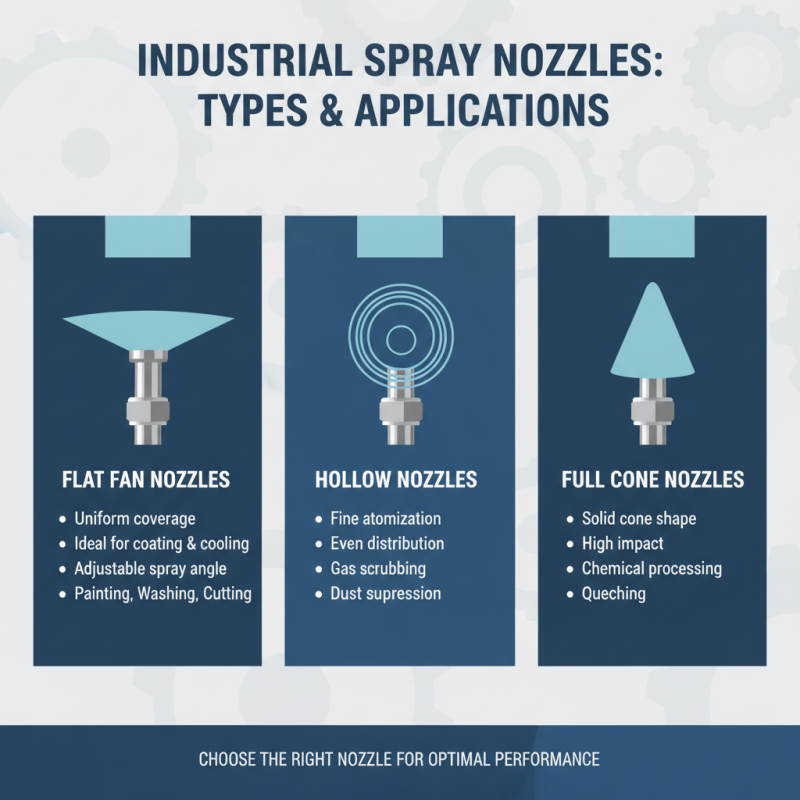
When selecting industrial spray nozzles, it is crucial to understand the various types available, as each design serves different applications and operates under distinct principles. The most common types include flat fan nozzles, hollow cone nozzles, and full cone nozzles. Flat fan nozzles provide a uniform spray pattern and are ideal for coating large surfaces or cutting through heavier fluids. Their design allows for adjustable spray angles, making them versatile for tasks ranging from painting to cooling operations.
Hollow cone nozzles, on the other hand, produce a cone-shaped spray that is ideal for applications requiring thorough coverage with minimal fluid usage. This type is especially useful in processes like cooling and washing, where the targeted area needs efficient fluid distribution without excessive overspray. Full cone nozzles deliver a solid, even spray pattern, making them suitable for washing, cooling, and some drying processes. Understanding these types, their functionalities, and their respective advantages helps in making informed decisions tailored to specific industrial needs.
Key Factors to Consider When Selecting Spray Nozzles
When selecting the best industrial spray nozzles for your needs, it is crucial to consider several key factors to ensure optimal performance and efficiency. One of the primary considerations is the application type, as different tasks require specific nozzle designs. For instance, according to a recent industry report by the Spray Technology Association, the selection of the right nozzle type can lead to efficiency improvements of up to 30% in various applications, such as cleaning, coating, or cooling.
Understanding whether a solid stream, mist, or foam spray is required will guide the decision-making process.
Another essential factor to consider is the fluid characteristics, including viscosity, temperature, and chemical compatibility. The nozzle material must be able to withstand the conditions without degrading over time. The same report highlights that using compatible materials can prevent nozzle wear and reduce maintenance costs by nearly 25%, resulting in better uptime and extended service life. Additionally, evaluating flow rates and pressure specifications is critical to ensuring the selected nozzle can meet operational demands effectively.
Lastly, the nozzle’s spray pattern and distribution uniformity are vital for achieving desired results. A study from the International Journal of Spray Technology emphasizes that nozzle design significantly influences spray characteristics, impacting application efficiency and resource usage. By carefully examining these factors, industries can optimize their spraying processes, leading to improved productivity and cost-effectiveness in their operations.
How to Determine the Spray Pattern Suited for Your Application
When selecting industrial spray nozzles, it's crucial to determine the spray pattern that best suits your specific application. Spray patterns can significantly impact the efficiency and effectiveness of your operations, as they dictate how the liquid is dispersed in the environment. Understanding the type of spray required can result in better resource utilization and reduced waste.
Data from industry reports indicate that up to 30% of fluid can be wasted due to improper spray patterns. For instance, flat fan nozzles are distinctive for creating a wide, flat spray ideal for coating and surface treatments, while hollow cone nozzles generate a finer mist and are suited for applications such as cooling and dust suppression. In contrast, full cone nozzles provide a circular spray pattern which is effective for processes that require uniform coverage, such as mixing and neutralization in chemical applications.
To determine the most suitable spray pattern, consider factors such as the fluid viscosity, required flow rate, and environmental conditions. According to a recent survey by the Fluid Handling Consortium, nearly 45% of facility managers reported that selecting incorrect spray patterns led to operational inefficiencies and increased costs. Therefore, conducting a thorough analysis of your requirements and understanding the application characteristics is vital in making informed decisions in choosing the right industrial spray nozzles.
2025: Choosing the Best Industrial Spray Nozzles
Evaluating Material Compatibility for Long-lasting Performance
When selecting industrial spray nozzles, understanding material compatibility is crucial for ensuring long-lasting performance and minimizing maintenance costs. According to a report by Freedonia Group, the global market for industrial spray nozzles is projected to reach over $1.3 billion by 2025, driven largely by increasing automation in manufacturing processes. The choice of nozzle material can significantly affect not just the efficiency of fluid delivery but also its ability to withstand harsh operational environments.
Different applications require nozzles made from a variety of materials, including stainless steel, plastic, and specialized alloys. For example, a study published in the Journal of Coatings Technology suggests that stainless steel nozzles are optimal for high-temperature applications due to their exceptional corrosion resistance and durability. In contrast, lightweight plastics might be more suitable for situations involving aggressive chemicals where chemical resistance is paramount.
Ensuring compatibility between the nozzle material and the fluid being sprayed is essential; failure to do so can result in premature wear, clogging, or even catastrophic nozzle failure, further highlighting the importance of thorough evaluation during the selection process.
Essential Maintenance Tips for Optimal Spray Nozzle Functionality
Maintaining optimal spray nozzle functionality is crucial for achieving the desired performance in industrial applications. Regular maintenance not only extends the lifespan of the nozzles but also enhances efficiency, reducing operational costs. According to a report by the Fluid Power Journal, properly maintained nozzles can improve efficiency by up to 15%, significantly impacting productivity in high-demand environments.
One key maintenance tip is to perform routine inspections for wear and tear. Nozzles can accumulate debris and scale that may affect their spray patterns and performance. The American Society of Mechanical Engineers recommends a thorough cleaning schedule, including back flushing and the use of ultrasonic cleaners, to ensure that nozzles remain unobstructed. Additionally, it's vital to check the alignment and positioning of the nozzles regularly, as misalignment can lead to uneven application and increased waste of materials.
Moreover, selecting the right materials for spray nozzles based on the working environment is critical. Corrosion resistance and compatibility with various chemicals should be considered. A study published in the Journal of Industrial Technology indicates that the right choice of materials can improve nozzle life by over 30% in harsh environments. Ultimately, adopting comprehensive maintenance strategies not only enhances nozzle performance but also contributes to the overall efficiency of industrial processes.